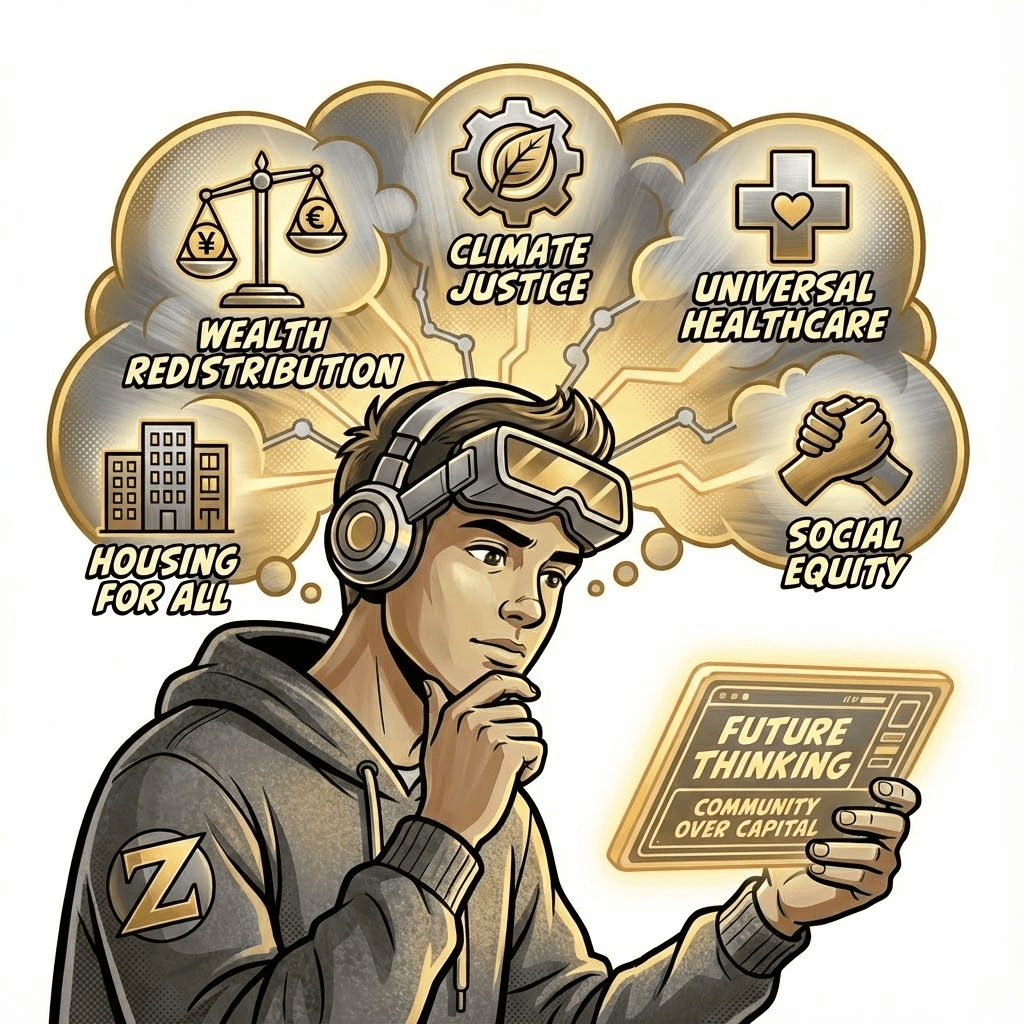
I. Introduction: Mapping the Economic Youth in a Biaxial World
The political landscape is undergoing a profound generational realignment, characterized by the emerging influence of Millennials and Generation Z (Gen Z). This demographic bloc is increasingly pivotal, having demonstrated a broad and decisive impact on recent elections, including the 2020 presidential contest and the 2018 and 2022 congressional elections.1 While the general perception holds that young voters are migrating leftward, a rigorous analysis requires moving beyond simplified ideological labels to dissect the specific dimensions of this shift.
1.1 The Poli Map Framework: Precision over Polemics
Understanding the current generational shift demands an analytical instrument capable of capturing political complexity. Traditional single-axis political tests often fail by conflating distinct belief systems, such as economic preferences and socio-cultural values. The Poli Map's dual-axis framework—which isolates economic policy (Left–Right) from socio-cultural values (Authoritarian–Libertarian)—is essential for accurately interpreting the political trajectory of the Millennial and Gen Z electorate.
On the economic dimension, the Left is defined by a belief in increased government intervention, rigorous regulation of capital, the implementation of expansive social safety nets, and significant wealth redistribution to manage market externalities and reduce inequality. The data overwhelmingly confirms that the rising generation is indeed moving toward this economic pole. However, this movement is not characterized by rigid, dogmatic adherence to historical socialist doctrine. Instead, the evidence suggests that the leftward tilt is driven by a necessity-driven pragmatism—a rational, collective response to acute structural economic failure and personal financial fragility. The central argument is that while the youth cohort demands Left economic solutions, this demand is fundamentally biaxial. To fully comprehend their economic demands, one must simultaneously acknowledge their parallel, and often more passionate, commitment to individual freedoms and autonomy, placing their dominant identity in the Left-Libertarian quadrant of the political map.3
1.2 The Necessary Distinction: Economic vs. Socio-cultural Trends
While this report focuses primarily on the economic axis, it is crucial to recognize the powerful socio-cultural trends that define this generation. Young voters consistently display strong social liberalism and libertarianism. They show significantly wider support for progressive stances on issues such as immigration and protest rights compared to the broader electorate.4 For example, on the sensitive issue of whether asylum seekers who enter the country illegally should be allowed to stay, young voters supported remaining by a 25-point margin, contrasting sharply with the overall electorate's opposition.4 Similarly, young adults (Gen Z, Millennials) are less likely than older cohorts to identify as conservative and are generally more supportive of individual liberty and diverse identities.5
This pronounced position on the social axis (Libertarian) often captures media attention and influences prevailing stereotypes. However, isolating the economic dimension reveals a deeper understanding of how their lived experiences of financial precarity translate into specific demands for systemic policy change. The generational push for economic security is profoundly linked to their desire for the freedom from constraint—a libertarian ideal applied to financial opportunity.
II. Structural Drivers of Economic Leftism: The Geography of Generational Precarity
The shift toward the Economic Left is not merely a matter of changing academic fashion or ideological preference; it is a direct consequence of the material conditions and chronic economic insecurity faced by young Americans. This section details how these structural factors provide a powerful mandate for interventionist government policies.
2.1 The Crisis of Existential Economics
For young voters, economic concerns are consistently top of mind.6 Polling data highlights a widespread pessimism regarding the current financial state, with 67% of young people stating that the economy overall is doing poorly.7 This generalized negativity reflects immediate, acute financial pressures that permeate daily life.
The financial struggles faced by this demographic are evidenced by behavioral shifts and increased fragility. Many Gen Z consumers are altering their spending patterns, cutting back on discretionary items, prioritizing essentials, and increasing reliance on secondhand goods.8 This is partly due to the high cost of living, which 51% of Gen Z surveyed identify as a barrier to financial success.9
A particularly worrying indicator of budget fragility is the reliance on high-interest debt for basic needs. A significant majority—70% of respondents under 40—report having taken on debt, utilizing credit cards, Buy Now Pay Later (BNPL) services, or payday loans to cover essential costs. This uniform trend spans across Democrats, Republicans, and Independents, demonstrating that financial struggle is a non-partisan mandate for change.7 These debt patterns, combined with data showing that more than 40% of Gen Z have made a late payment, up seven points from the previous year, reveal a generation flirting with financial instability despite efforts to control spending.10
This linkage between acute financial fragility and the rising demand for socialist or interventionist policies suggests a powerful underlying dynamic. This generational economic leftism is not merely an ideological movement; it is a survivalist mandate. The demand is pragmatic: for basic social insurance and guaranteed affordability that can mitigate these acute pressures.
2.2 The Weight of Debt: A Resource That Hurts You
The economic struggles of Millennials and Gen Z are often crystallized by the burden of student debt, which profoundly impacts their mid-twenties and beyond. Research indicates a significant paradox: student debt initially functions as a resource, helping individuals access and remain in college.11 This debt acts as an investment that instills a sense of mastery and control.
However, upon entering repayment in their mid-twenties, this "resource" swiftly transforms into a liability. The high principal and interest payments become a chronic stressor, associated with an increase in depressive symptoms and health problems.11 While a college degree generally correlates with socioeconomic benefits, these benefits are diminished and delayed by the weight of the debt itself.11 The investment is often described as a "gamble," one that does not pay off for all participants, leading to profound disillusionment when the social contract fails to deliver prosperity.11
This financial insecurity extends directly into core life milestones, particularly housing. A substantial 42% of young people report worrying about their ability to afford rent or a mortgage.7 The inability to secure basic needs, such as affordable housing, alongside the chronic burden of debt, creates a widespread sense that the governing economic ideology—one built on market supremacy and low regulation—has fundamentally failed. The premise that individual effort and debt-financed education guarantee upward mobility has been undermined. This experience legitimizes the demand for state intervention (Economic Leftism) to correct market externalities, regulate costs, and restore a sense of economic security. The perception of a broken social contract directly fuels the shift toward economic interventionism.12
2.3 The Fatalism Paradox: Demanding Action While Distrusting Capacity
Adding a layer of complexity to the youth political profile is the presence of deep-seated fatalism regarding the possibility of effective change. Researchers from UC Berkeley identify a substantial generation gap: young voters across the political spectrum—including young conservatives—are converging toward agreement on key issues and demanding effective government action to solve critical problems such as economic inequality, climate change, and the costs of education and healthcare.1 Young people, regardless of their political boundaries, are notably more likely than older generations to believe that "government should do more to solve society's problems, even if it means higher taxes for all".12 This egalitarian consensus even extends to young conservatives, who are found to be more egalitarian and fatalistic than their older conservative counterparts.1
Paradoxically, while demanding expansive government solutions, these same young voters are "fatalistic," sharing a pervasive belief that fractured, dysfunctional government systems are incapable of addressing the existential risks they face.1
This analytical juxtaposition is significant because it suggests that support for Left economic policies is conditional upon the perceived competence of the state. Young voters seek an antidote to their disillusionment.12 Therefore, appealing to this demographic requires more than rhetorical commitment to progressive values; it demands tangible, results-oriented solutions, such as specific and meaningful student debt relief, that demonstrate the state's functional capacity to deliver economic stability.13 A political platform cannot simply be ideologically Left; it must also be organizationally effective to earn the trust of this skeptical generation.
III. The Policy Evidence: Measuring the Leftward Gravitation
To measure the commitment to the Economic Left, it is insufficient to rely solely on self-identification. A closer examination of support for specific redistributive and regulatory policies provides a robust empirical measure of the leftward movement.
3.1 Decoding the "Socialism" Label: Semantic Drift vs. Policy Prescription
The nominal ideological affinity for certain terms among young people often generates controversy. A Cato Institute/YouGov survey found that 62% of Americans aged 18–29 hold a "favorable view" of Socialism, with a considerable 34% viewing "Communism" favorably.14 Similarly, in the United Kingdom, 67% of young people (aged 16 to 34) expressed a desire to live in a socialist economic system.15
While critics interpret these figures as flirting with historical tyranny, a more nuanced analysis suggests widespread semantic drift. For this generation, these labels do not necessarily signal mass support for historical command economies or authoritarian state control. Instead, "Socialism" acts as a strong emotional and directional preference for the Economic Left, representing a fundamental rejection of the current neoliberal status quo characterized by rising inequality and precarity. When these young voters express support for socialism, they are primarily signaling a demand for universal public services, robust social safety nets, and systemic government intervention to ensure economic equity.12 They seek a system that guarantees the shared ideals of a functioning economy rather than an abandonment of democracy.
3.2 Redistribution and Tax Policy: The Appetite for Intervention
Empirical support for progressive taxation and wealth redistribution confirms the underlying commitment to Economic Left principles. Young voters generally support policies designed to curb concentrated wealth and fund social services.
In the UK, significant public support exists for measures such as a 2% annual wealth tax levied on individuals with assets exceeding £10 million (supported by 68%).16 Furthermore, policies like imposing windfall taxes on energy companies and banks that report unexpected profits are popular, with 71% of the general population supporting a one-off wealth tax on the richest individuals.17 These measures indicate a concrete desire to shift the tax burden away from labor and toward concentrated capital and economic windfalls.
Furthermore, on foundational economic floor policies, there is strong consensus across international boundaries. For instance, 69% of young people in Europe support an EU-wide minimum wage.18 This illustrates widespread agreement on the need for government intervention to establish a baseline standard of living and reduce pay gaps. The policy alignment is clear: the youth demographic strongly favors interventionist tools to enforce equity.
3.3 The Universal Basic Income (UBI) Contradiction: Nuance is Essential
One of the most revealing policy areas illustrating the conditional nature of the youth shift is Universal Basic Income (UBI). Older polling data suggests a strong initial ideological leaning toward UBI, with adults under age 30 favoring the proposal by approximately two-to-one (67% favor).19 This broad support aligns with the generational mandate for economic security.
However, a more recent Harvard IOP poll shows a dramatic contradiction: when faced with a specific, perhaps less defined, UBI policy, support collapsed. Just 14% of young Americans supported the policy, while 54% opposed it, and support was almost nonexistent among young Democrats (only 4% backed it).20
This stark contrast highlights that youth support for the Economic Left is highly conditional and pragmatic. While they strongly desire the outcome of such policies—namely, guaranteed economic security and reduced precarity—they are simultaneously wary of policies perceived as poorly structured, fiscally irresponsible, or potentially damaging to economic stability. The political direction is Left, but the successful implementation must address concerns about viability, funding mechanisms, and perceived fairness. The youth are seeking effective solutions, not merely ideological tokens.
3.4 Reforming the Firm: The Shift to Stakeholder Capitalism
The youth perspective on the economy extends beyond taxation and welfare to the very structure of corporate governance. Younger generations exhibit a pronounced preference for Stakeholder Capitalism over the prevailing Shareholder Capitalism model.21 This reflects a modern form of Economic Leftism that seeks to reorient economic power by regulating corporate behavior to serve broader social interests.
In this model, corporations are expected to create value for all parties involved, including employees, communities, and the environment, not just shareholders.21 This shift encourages sustainable practices and fair wages. The movement is so strong that 44% of Millennials and Gen Z agree that the CEOs of big businesses should be more involved in solving social problems.22
This preference effectively merges economic and social values, treating large corporations as quasi-public institutions that require accountability beyond quarterly profits. The demand for corporate social responsibility demonstrates a foundational belief that the market, left unregulated, prioritizes profit over social good—a classic Economic Left critique—and therefore requires intervention, either through social pressure or regulation, to align economic activity with societal well-being.
IV. The Left-Libertarian Synthesis: Placing Young Voters on the Poli Map Coordinates
The defining feature of the generational political shift is the convergence of two independent dimensions: economic egalitarianism and socio-cultural freedom. Integrating the economic findings with the social dimension allows for precise placement of the generational center of gravity on the Poli Map grid.
4.1 The Dual Shift: Economic Egalitarianism Meets Social Freedom
The collective empirical data confirms a political identity characterized by high scores on the Economic Left axis (a demand for resource equity and systemic intervention) and high scores on the Social Libertarian axis (a demand for personal autonomy, social diversity, and reduced state control over individual lifestyles).4
This composite ideology positions the rising generation in a distinct quadrant that differs fundamentally from the historical cores of both major U.S. political parties. The younger cohort is largely defined by this Left-Libertarian alignment, rejecting both the traditional Right's tolerance for economic inequality and the Social Authoritarian impulse to regulate personal choices.
4.2 Identifying the Generational Center: Activist Egalitarians
Typology studies provide a granular view of the youth electorate, confirming the concentration in the Left-Libertarian space. Analyzing Millennials (a close proxy for Gen Z trends) reveals five distinct political groups.3 The single largest of these groups, representing 39% of the surveyed population, is the Activist Egalitarians.3
This group is defined by its concern for social, political, and economic inequality, coupled with strong support for government action to combat these issues.3 Crucially, this group also exhibits high levels of civic engagement and a demand for individual liberty, serving as the nucleus of the Left-Libertarian quadrant. The presence of this large, unified bloc confirms that the generational center is defined by a commitment to equality across both the economic and social dimensions.
4.3 Visualizing the Generational Center
To provide clarity for users of the Poli Map, the analysis translates the findings on generational political identities directly into the dual-axis framework. The data indicates that while there is diversity within the youth electorate, the largest and most influential segment occupies a space defined by both egalitarian policy preferences and anti-authoritarian social stances. This dominant bloc represents a Left-Libertarian wedge in contemporary politics. This group is unified by a profound desire for systemic change but is wary of traditional top-down authority, demanding expansive economic policies without undermining personal freedoms.
| Group Classification | Approx. % | Economic Orientation | Socio-cultural Orientation | Key Policy Focus |
|---|---|---|---|---|
| Activist Egalitarians | 35–40% | Strongly Left (High Intervention) | Strongly Libertarian (High Freedom) | Inequality, Climate Action, Social Justice |
| Participatory Libertarians | 25–30% | Right (Market Skepticism) | Strongly Libertarian (High Freedom) | Individual Liberty, Anti-Authoritarianism |
| Disempowered/Alienated Egalitarians | 10–15% | Left (Welfare/Safety Nets) | Moderate/Libertarian | Survival, Housing, Debt Relief |
| Lost and Disengaged | 15–20% | Undefined/Apolitical | Undefined/Apolitical | N/A (Disconnection from civic life) |
The table clarifies that even the second largest group, the Participatory Libertarians, shares the generational commitment to Social Libertarianism, differing only on the economic dimension. However, the sheer size of the Activist Egalitarian group demonstrates the gravitational pull toward the Economic Left.
V. Engagement with Modern Cleavages: AI, Climate, and Globalization
The contemporary relevance of the youth political alignment is most clearly demonstrated in their views on new political cleavages—specifically, technology, climate, and globalization. The dual-axis framework allows for the interpretation of these issues not merely as environmental or technological concerns, but as expressions of economic ideology.
5.1 Climate Change: Regulation as Economic Restructuring
Younger generations view climate change as an existential economic threat that requires substantial government intervention and market restructuring. They are demonstrably more active on climate issues than older cohorts23 and their concerns translate directly into demands for regulatory economic policy.
Specifically, youth support the use of punitive regulation (Economic Left) to mitigate environmental damage and ensure climate justice. European youth, for instance, overwhelmingly want regulatory bodies, like the European Union, to be stricter on the highest polluting companies.18 This stance aligns with the broader demand for Stakeholder Capitalism, where environmental externalities are treated as a collective cost that must be managed by the state and borne by the entities responsible for the pollution. The push for climate action is fundamentally a demand for economic accountability and a regulated market.
5.2 Digital Governance: Regulating the New Oligopolies
The rapid integration of Artificial Intelligence (AI) and digital infrastructure into daily life presents a novel test for generational economic views. While younger adults globally report high levels of digital engagement and AI adoption, particularly in emerging economies24, they simultaneously express critical views on its governance.
Younger citizens demand governance frameworks for public services that prioritize transparency, fairness, and human-centric design.25 They caution that AI should not reinforce inefficiency or narrow innovation by focusing misplaced metrics of accuracy and performance over genuine human impact and social value. There is concern that reliance on perpetually dependent AI systems in public infrastructure is risky.25
This demand for accountable, human-centric AI governance directly extends the traditional Economic Left principle of controlling essential public utilities into the digital age. It represents an implicit challenge to the unchecked power of major technology firms. By demanding that digital infrastructure—increasingly viewed as the new means of production and critical public service delivery—be managed for social value and accountability, the youth are arguing against narrow profit motives and for a form of regulated public stewardship over digital capital.
VI. Conclusion: A Fatalistic Pragmatism and the Future of the Poli Map
6.1 Synthesis: The Confirmation of a Pragmatic Left Trajectory
The comprehensive analysis of generational polling and political behavior confirms a decisive, measurable shift among Millennials and Gen Z toward the Economic Left. This movement is driven not by abstract ideological purity, but by the tangible realities of chronic financial insecurity, crushing debt, and the inability to access essential goods like housing and healthcare.7 This is a movement rooted in pragmatic necessity, where government intervention is viewed as the only practical mechanism to restore stability and affordability in a structurally unequal economy.
This economic egalitarianism operates synergistically with their established commitment to Social Libertarianism. The generational center is located firmly in the Left-Libertarian quadrant, characterized by Activist Egalitarians who demand resource equity alongside robust personal freedoms.3
6.2 The Challenge of Disillusionment and Engagement
While the political disposition is clear, the pervasive element of fatalism poses a significant challenge to effective political engagement and turnout.1 Young voters, though demanding expansive government action (even if it means higher taxes), simultaneously distrust the capacity of the current political system to deliver meaningful results.1
For political movements to successfully engage this cohort, rhetoric must be coupled with clear, tangible, high-impact policy solutions that directly address the core economic stressors—affordability, debt, and the costs of education and healthcare. Policy must serve as an effective "antidote" to this widespread disillusionment, proving that government action can, in fact, solve the existential problems facing the rising generation.12
6.3 Implications for Poli Map: Tracking the Tectonic Shift
The findings indicate that the political center of gravity is not stationary. For Millennials and Gen Z, the baseline expectation for political moderation is shifting substantially leftward on the economic axis. The coordinates that once defined political centrism—often associated with deregulation and fiscally conservative policies—are being measured against a dramatically more egalitarian and interventionist baseline by the rising generation.
The Poli Map's methodological rigor and dual-axis model are invaluable tools for tracking this tectonic shift. By separating economic policy from social values, the platform enables users to accurately understand that their policy preferences, while often labeled as radical by older generations or single-axis analyses, may in fact represent the emerging mainstream political consensus of the future. The enduring importance of political mapping lies in its ability to transparently locate individuals within this complex, evolving ideological landscape.
Take the Political Spectrum quiz to discover where you stand on the dual-axis map and understand how your views compare to the emerging generational consensus.
Works Cited
- Young voters have growing power, but broken politics leave them 'fatalistic,' studies find — University of California, accessed December 8, 2025
- How economic concerns are shaping the youth vote in 2024 — Brookings Institution, accessed December 8, 2025
- Millennials' Diverse Political Views — Tufts' CIRCLE, accessed December 8, 2025
- Spring 2025 Poll — Yale Youth Poll, accessed December 8, 2025
- A Political and Cultural Glimpse Into America's Future: Generation Z's Views on Generational Change — PRRI, accessed December 8, 2025
- Harvard Youth Poll (47th Edition) — Harvard IOP, accessed December 8, 2025
- NEW POLL: Young voters, squeezed by the economy, believe government should do more to fix it — Economic Security Project, accessed December 8, 2025
- Why Gen Z Is Breaking the Mold on Holiday Spending by Choosing to Save — Investopedia, accessed December 8, 2025
- Confronted with Higher Living Costs, 72% of Young Adults Take Action to Improve their Financial Health — Bank of America, accessed December 8, 2025
- The Gen Z paradox: Spending less, expecting more — PwC, accessed December 8, 2025
- Debt Takes a Toll — Harvard Law School Center on the Legal Profession, accessed December 8, 2025
- Young Voters Have Growing Power, but Broken Politics Leave Them 'Fatalistic,' Studies Find — UC Berkeley, accessed December 8, 2025
- A greater focus on tangible economic issues like student debt relief could help Democrats win back young voters — LSE Blogs, accessed December 8, 2025
- Young Americans Like Socialism Too Much—That's a Problem Libertarians Must Fix — Cato Institute, accessed December 8, 2025
- Political views of Generation Z — Wikipedia, accessed December 8, 2025
- Public overwhelmingly back wealth tax package to fix public services and rebuild Britain — TUC, accessed December 8, 2025
- Decoding Populism: Voters considering Reform UK want wealth taxes — Best for Britain, accessed December 8, 2025
- Europe's largest Gen Z-focused research ever conducted — Foundation for European Progressive Studies, accessed December 8, 2025
- The majority of Americans are against a universal basic income - study — World Economic Forum, accessed December 8, 2025
- Harvard Youth Poll (50th Edition) — Harvard IOP, accessed December 8, 2025
- How Gen Z Is Redefining Capitalism in the 21st Century — Voices of Capitalism, accessed December 8, 2025
- Millennial and Gen Z Views of Free Markets, Social Issues, and the Workplace — Wake Forest University, accessed December 8, 2025
- Gen Z, Millennials Stand Out for Climate Change Activism, Social Media Engagement With Issue — Pew Research Center, accessed December 8, 2025
- OECD-Cisco research finds stark geographical and generational divides in AI uptake and digital well-being — Cisco, accessed December 8, 2025
- Citizen-first AI: How youth can shape AI in public services? — World Economic Forum, accessed December 8, 2025